
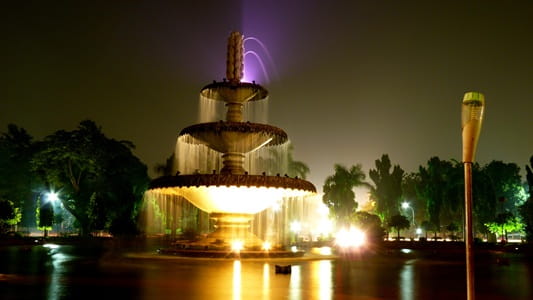
Sukhadia Circle Udaipur is the city’s most beloved public gathering space — not a commercial hub or a transit junction, but a roundabout that works primarily as a place where people come to be outside. The circle is located in Panchwati, the northern suburb of Udaipur, on the road to Ranakpur and Mount Abu, PIN code 313004. At its centre sits a three-tiered fountain of white marble, 21 feet high, crafted in the shape of a wheat-ear motif symbolising prosperity. Construction began in 1968 and the fountain was opened to the public in 1970, dedicated to Mohan Lal Sukhadia — the longest-serving Chief Minister of Rajasthan, who governed the state for seventeen years across multiple terms between 1954 and 1971, and who came from this very region. The circular pond around the fountain spreads over 21 acres — and in a city defined by its famous lakes, Sukhadia Circle is the locals’ own water feature, built on a human scale for daily use rather than royal spectacle.
The Structure: Marble, Motif and the Evening Light
The fountain is built entirely of white marble — fitting for a city in Rajasthan, where marble is quarried, carved, and worked into everything from temples to housewares. The wheat-ear design is not decorative accident: it was chosen deliberately to represent agricultural prosperity and the abundance Sukhadia’s administration sought to bring to rural Rajasthan. At 21 feet, the fountain is not imposing, but after sunset, when the surrounding lights reflect off the water and the fountain itself is illuminated, it becomes the kind of scene that people return to repeatedly without quite being able to explain why. Timings are 6 AM to 9:30 PM, and entry to the circle itself is free.
What You Can Do Here
Paddle boats on the pond cost ₹40 per person. Two-seater motor boats run ₹100 per person, and four-seater versions ₹200 per person. Camel and horse rides are available around the circle’s perimeter. A children’s play zone operates alongside the rides. Food stalls — one of Sukhadia Circle’s consistently praised features — offer local Rajasthani snacks, chaats, cold drinks, and tea at prices that remain accessible to everyday Udaipur residents rather than calibrated for tourist margins. The street food at Sukhadia Circle is considered by locals the best informal eating in the city — a designation it earns not from any single famous dish but from the reliable, affordable, consistent quality that comes from a market sustained by local repeat customers rather than one-time visitors.
Saheliyon Ki Bari — the famous garden of the maids of honour, one of Udaipur’s most visited historical monuments — is just 700 metres from Sukhadia Circle. This proximity means visitors combining both in a single afternoon outing are doing something genuinely efficient rather than tourist-map convenient.
Sukhadia Circle in the City Calendar
During Diwali, the Mewar Festival, and New Year’s Eve, the entire Sukhadia Circle area transforms into one of Udaipur’s major celebration venues. The combination of the illuminated fountain, the surrounding gardens, the food stalls, and the open-air character of the space makes it a natural gathering point for the city during festival periods in a way that no enclosed mall or commercial venue can replicate.
Who Named This Circle and Why It Matters
Mohan Lal Sukhadia served as Chief Minister of Rajasthan from 1954 to 1971 — an almost unbroken seventeen-year tenure that made him the dominant figure in the state’s post-independence development. He was from Chittorgarh, part of the Mewar region of which Udaipur is the cultural capital. His administration focused on agricultural reform, water resource development, and industrial expansion for Rajasthan. The circle’s wheat-ear motif was not designed by bureaucrats as symbolic decoration — it was chosen to specifically honour the agricultural and rural development agenda that defined his political career. The Bhartiya Lok Kala Mandal — Udaipur’s significant folk art museum and cultural institution — is approximately 900 metres from the circle, reinforcing the cultural weight of the Panchwati zone where the circle sits.
Connectivity
Udaipur City Railway Station is approximately 5 km from Sukhadia Circle. Maharana Pratap Airport is approximately 28 km. The Ranakpur and Mount Abu Road that runs through the circle connects northward toward two of the most important heritage sites in the broader Udaipur region — the Ranakpur Jain Temples (approximately 90 km) and Mount Abu hill station (approximately 160 km).
FAQs About Sukhadia Circle Udaipur
Q1. Who was Mohan Lal Sukhadia, and why is this circle named after him?
A: Mohan Lal Sukhadia was Chief Minister of Rajasthan for approximately seventeen years across 1954–1971 — the longest tenure in the state’s history. A native of the Mewar region, his administration prioritised agricultural development, which the fountain’s wheat-ear motif symbolises. The circle was built in 1968 and opened in 1970 in his honour.
Q2. What is the pincode of Sukhadia Circle Udaipur?
A: PIN code 313004. The circle is in Panchwati, northern Udaipur, on the Ranakpur–Mount Abu Road.
Q3. What are the timings and entry fees at Sukhadia Circle?
A: The circle is open daily from 6 AM to 9:30 PM. Entry is free. Paddle boats cost ₹40 per person; two-seater motor boats ₹100 per person; four-seater boats ₹200 per person. Camel and horse rides are available at separate rates.
Q4. How far is Saheliyon Ki Bari from Sukhadia Circle?
A: Just 700 metres — the two can be combined in a single outing very easily.
Q5. What is the best time to visit Sukhadia Circle Udaipur?
A: Evenings after 7 PM, when the fountain lights up and the food stalls are at their busiest. Festival periods — Diwali, Mewar Festival, New Year’s Eve — bring the most vibrant atmosphere, but any weekday evening gives a good experience of how Udaipur’s residents actually use and enjoy this space.