
Kala Ghoda Circle Vadodara is among the most historically layered traffic junctions in all of Gujarat — a roundabout whose identity is entirely defined by a single bronze sculpture placed at its centre over a century ago. The circle’s address is Kala Ghoda Station Road, Dak Bungalow, Sayajiganj (also Sarod, Sayaji Gunj), Vadodara, Gujarat 390005. Justdial rates it 4.5 out of 5 on 32 reviews. Vadodara Junction Railway Station is approximately 460 metres away — making this one of the most railway-proximate heritage circles in the country. The main city bus stand is even closer. The circle sits in the Akota Assembly Constituency, under MLA Chaitanya Makarandbhai Desai, within the Vadodara Lok Sabha constituency with MP Ranjanben Bhatt. Elevation is 36 metres.
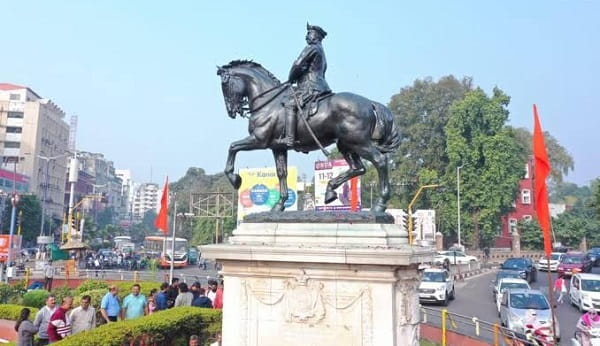
What Kala Ghoda Means — The Statue and Its Story
Kala Ghoda means Black Horse in Gujarati. The name refers to the life-sized bronze equestrian statue of Maharaja Sayajirao Gaekwad III that stands at the centre of this circle, directly opposite the main entrance of Sayaji Baug. The statue’s horse is black-coloured — its dark bronze finish giving the entire circle and, by extension, the city’s most prominent public space its popular name.
The statue was cast by sculptor Francis Derwent Wood in bronze at a cost of ₹60,000 — an extraordinary sum for the early 20th century. It was unveiled in 1914 (with some records indicating March 1907 for an earlier ceremony — historian Chandrashekhar Patil has clarified, based on a photograph he holds, that the actual inauguration was on 18 March 1914, performed by Maharaja Holkar of Indore). The statue was erected by public subscription — meaning the citizens of Baroda collectively commissioned it as a tribute to their Maharaja, rather than it being a state-funded project. The plinth is approximately 8 feet tall in rectangular stone, with inscriptions in Gujarati, Marathi, and English. Roman-style relief carvings of a female figure adorn the smaller sides. The horse’s two front legs are raised in the air.
The statue depicts Sayajirao Gaekwad III — the Maharaja of Baroda from 1875 to 1939, one of India’s greatest princely state rulers, who introduced compulsory free primary education in Baroda in 1906 (decades before independence), built Sayaji Baug and the Baroda Museum, established the Bank of Baroda, and whose progressive governance became a template studied internationally. The statue features his distinctive mustache — noted by reviewers as “unique among statues of him.”
The 2024 Restoration
In January 2024, the century-old statue was unveiled after a major restoration. The bronze had suffered corrosion and structural damage over decades. Restoration was carried out by a team from the Indira Gandhi National Centre for the Arts (IGNCA) Conservation Division and Regional Centre Vadodara, under the Culture Ministry. The IGNCA stated that the restoration “embodies the city’s rich heritage and artistic spirit, encapsulating the essence of Vadodara’s cultural legacy.” The restored statue — now structurally sound and with its bronze surface renewed — was re-unveiled to the public.
Sayaji Baug — The Circle’s Natural Companion
The main entrance gate of Sayaji Baug (also known as Kamati Baug) is directly opposite Kala Ghoda Circle. Sayaji Baug was gifted to the citizens of Vadodara by Maharaja Sayajirao Gaekwad III in 1879. It spans 113 acres on the banks of the Vishwamitri River, making it one of the largest public gardens in western India, with over 98 species of trees. Inside are the Baroda Museum and Picture Gallery (built 1894, designed to resemble the Victoria and Albert Museum of London), the Sardar Patel Planetarium, and the Sayaji Baug Zoo. Thousands of Barodians use the garden daily for morning walks. The garden’s main gate at Kala Ghoda Circle is 800 metres from Vadodara Junction — confirming that the circle, the garden, and the railway station form a tight geographic triangle at the absolute centre of the city.
Connectivity and Surroundings
Vadodara Junction Railway Station at 460 metres places Kala Ghoda Circle within walking distance of one of India’s major railway junctions on the Delhi-Mumbai mainline — arguably the busiest rail corridor in Asia. The Sayajiganj zone where the circle sits also houses art galleries, the Baroda Museum, the city bus stand, upscale hotels, banks, and Vadodara’s central commercial establishments. Local art exhibitions and cultural events are regularly hosted in the vicinity of the circle, consistent with Vadodara’s identity as Kala Nagari — the City of Art. Street food stalls and cafes are described by visitors as part of the circle’s daily character. The best photography opportunities at the circle are at sunrise and sunset, when the bronze statue and the Sayaji Baug entrance gate create a heritage frame unlike any other junction scene in Gujarat.
FAQs About Kala Ghoda Circle Vadodara
Q: What is the meaning of Kala Ghoda Circle Vadodara?
A: Kala Ghoda means Black Horse in Gujarati. The name refers to the life-sized bronze equestrian statue of Maharaja Sayajirao Gaekwad III at the circle’s centre, whose dark bronze horse gives both the circle and the surrounding area their name.
Q: Who made the Kala Ghoda statue in Vadodara and when was it unveiled?
A: The bronze statue was sculpted by Francis Derwent Wood at a cost of ₹60,000, funded by public subscription. It was unveiled on 18 March 1914 by Maharaja Holkar of Indore (a plaque on the statue records 5 March 1907, which historian Chandrashekhar Patil has identified as an error based on a dated photograph of the inauguration).
Q: How far is Kala Ghoda Circle from Vadodara Junction Railway Station?
A: Approximately 460 metres — an easy 5-minute walk. The main city bus stand is even closer, making the circle one of India’s most transport-proximate heritage roundabouts.
Q: What was restored at Kala Ghoda Circle in 2024?
A: The century-old bronze equestrian statue of Maharaja Sayajirao Gaekwad III was restored by the IGNCA Conservation Division after suffering corrosion and damage. It was re-unveiled in January 2024 after months of dedicated restoration work.
Q: What is directly opposite Kala Ghoda Circle?
A: The main entrance gate of Sayaji Baug — a 113-acre public garden gifted to Vadodara’s citizens by Maharaja Sayajirao Gaekwad III in 1879, housing the Baroda Museum and Picture Gallery, Sardar Patel Planetarium, and Sayaji Baug Zoo.