
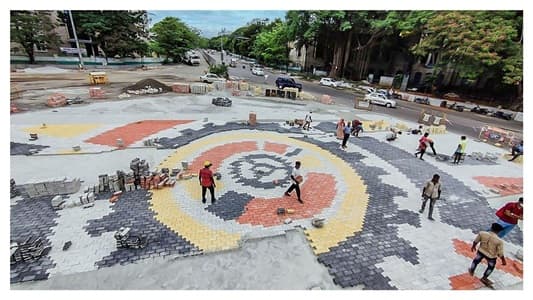
KR Circle Bengaluru — formally Krishna Rajendra Circle — sits at what is arguably the most institutionally saturated intersection in all of Karnataka. The circle’s address is Ambedkar Veedhi, Sampangi Rama Nagar, Bengaluru, Karnataka 560009, with KG Road as the post office. It falls under the Shivajinagar Assembly Constituency, represented by MLA Rizwan Arshad, within the Bangalore Central Lok Sabha constituency with MP PC Mohan. At 874 metres above sea level and coordinates 12°58’N, 77°35’E, it sits at the gravitational centre of Bengaluru’s civic, administrative, and legislative identity. NH-275 and NH-75 are both accessible from the zone. KSR Bengaluru City Junction and Bengaluru Cantonment Railway Station are the nearest mainline rail points.
What Surrounds KR Circle — The Institutional Inventory
Standing at KR Circle and looking in any direction, the institutions visible or within a few hundred metres constitute a catalogue of Karnataka’s governing apparatus. Vidhana Soudha — Karnataka’s Legislative Assembly building, constructed in 1954 in Neo-Dravidian style by convicts under Chief Minister Kengal Hanumanthaiah, inaugurated in 1956, and arguably Bengaluru’s most imposing building — faces Ambedkar Veedhi directly. Vikasa Soudha, the annexe building inaugurated in 2005, stands to its south. The High Court of Karnataka occupies the Attara Kacheri — an 1864-built red brick neoclassical building inside Cubbon Park that once housed the High Court of Mysore after independence.
Cubbon Park itself — 300 acres of managed urban forest in the heart of Bengaluru — has its most prominent entrance gate on Ambedkar Veedhi adjacent to KR Circle. Government Sri Krishnarajendra Silver Jubilee Technological Institute is at KR Circle near Vidhana Soudha. BMTC bus stops KR Circle, Maharani’s College, Vidhana Soudha, Telephone Exchange (Vidhana Soudha), and Kaveri Bhavan are all within immediate walking distance.
In 2025, the Government of Karnataka revised its public access policy for Vidhana Soudha, introducing structured guided tours and allowing public entry to designated interior spaces — a change that makes KR Circle a starting point for heritage tourism that was previously accessible only as an exterior viewing spot.
Who Krishna Rajendra Was
KR Circle is named after Sri Krishnaraja Wadiyar IV — the Maharaja of Mysore from 1894 to 1940, known as the philosopher-king who oversaw Mysore’s transformation into one of British India’s most progressive princely states. Under his reign, Mysore built the Krishnarajasagara Dam, introduced universal primary education, established the University of Mysore, and electrified Mysore city — among the first in Asia to do so. He was known for his scholarship, his patronage of the arts, and his deeply humane governance. KR Market (Krishna Rajendra Market), KR Road, KR Sagar Dam, and KR Circle in Bengaluru all carry his name — testimony to the affection Karnataka’s people held and continue to hold for his legacy.
Metro and Transport at KR Circle
Cubbon Park Metro Station (station code CBPK), an underground station on the Purple Line opened 30 April 2016, is located on Ambedkar Veedhi — directly within the KR Circle zone. The Purple Line connects eastward to Whitefield (Kadugodi) and westward to Challaghatta, covering the full east-west IT and heritage corridor of Bengaluru in a single ride. The Vidhana Soudha Metro Station is the adjacent station on the same line. Multiple BMTC routes serve the circle — routes 402, 402A, 402E and several others pass through, providing comprehensive bus connectivity across northern, southern, and eastern Bengaluru.
The Civic and Cultural Significance
The research project “Zero Point Bombay” used Horniman Circle in Mumbai as the city’s narrative origin — the equivalent framing for Bengaluru would use KR Circle. Cubbon Park’s Ambedkar Veedhi entrance, the red sandstone Attara Kacheri reading as both art and justice, Vidhana Soudha’s floodlit grandeur after sunset, and the institutional weight of BESCOM headquarters on Cubbon Park Road all accumulate here. The circle is less a traffic junction than a civic statement about what Bengaluru is — its government, its green spaces, and its administrative heritage.
FAQs About KR Circle Bengaluru
Q1. What does KR Circle stand for in Bengaluru?
KR stands for Krishna Rajendra — named after Sri Krishnaraja Wadiyar IV, the Maharaja of Mysore (1894–1940) who oversaw the state’s transformation into one of British India’s most progressive principalities, known for the Krishnarajasagara Dam, electrification of Mysore, and the founding of the University of Mysore.
Q2. What is the pincode of KR Circle Bengaluru?
PIN code 560009. The post office is KG Road. The circle is in Sampangi Rama Nagar, under the Shivajinagar Assembly Constituency.
Q3. Which metro station is nearest to KR Circle Bengaluru?
Cubbon Park Metro Station (station code CBPK) on the Purple Line, opened 30 April 2016, is directly at the circle on Ambedkar Veedhi — underground, within walking distance of the Vidhana Soudha entrance.
Q4. Which major institutions are at or near KR Circle?
Vidhana Soudha (Karnataka Legislature), Vikasa Soudha (government annexe), Attara Kacheri (High Court of Karnataka, built 1864), Cubbon Park (300 acres), Government Sri Krishnarajendra Silver Jubilee Technological Institute, and BESCOM headquarters — among others.
Q5. Can visitors enter Vidhana Soudha near KR Circle?
Since 2025, the Government of Karnataka has introduced structured guided tours allowing public entry to designated interior spaces. Previously accessible only as an exterior landmark.