
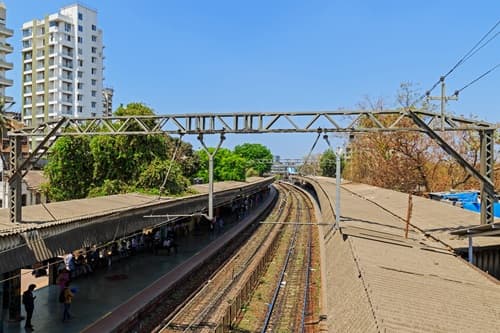
King Circle Mumbai carries a colonial naming that survived independence more intact than most British-era place names in the city. The circle is named after King’s Circle Park — a garden named after King-Emperor George V — in the Matunga East zone of central Mumbai, PIN code 400019, with Matunga as the post office. King’s Circle Railway Station (station code KCE) sits directly here on the Harbour Line of Mumbai Suburban Railway, and the nearby Matunga Railway Station on the Central Line is the adjacent station. That dual rail access — Harbour Line at King’s Circle and Central Line at Matunga — within 300 metres of each other gives this junction a transit density comparable to Dadar’s, at a fraction of Dadar’s commercial noise.
Location in Matunga East
Matunga is described in Mumbai urban writing as “the South Indian quarter of Mumbai” — the zone where Tamil Brahmin, Telugu, and South Indian migration to Bombay concentrated during the early 20th century, creating a neighbourhood identity that persists in its restaurants, sabha halls, music institutions, and Udupi eateries that remain among Mumbai’s best-regarded. Matunga Road and King’s Circle stations were constructed in the early 20th century as Mumbai’s suburban expansion pushed northward from South Bombay. The Harbour Line station at King’s Circle connects to CSMT and Panvel via Wadala Road and Kurla, enabling access to eastern suburbs and the emerging Navi Mumbai International Airport corridor.
Dr Babasaheb Ambedkar Road is the primary arterial road of the zone. The Wadala Assembly Constituency covers King’s Circle, with MLA Kalidas Nilkanth Kolambkar. The Lok Sabha constituency is Mumbai South Central, with MP Rahul Ramesh Shewale.
The Renaming Question
In March 2024, Maharashtra government gave official approval to rename King’s Circle station Tirthankar Parshvanath — after Parshvanatha, the 23rd Jain tirthankara — in response to advocacy from the Jain community. As of mid-2026, the practical status of the renaming in daily railway usage remains unclear: the station code KCE and the name King’s Circle continue to appear in timetables and commuter references. This ambiguity is worth noting for anyone navigating Mumbai’s suburban rail system.
Educational Institutions — the Circle’s Defining Character
South Indian Education Society (SIES) High School — one of Mumbai’s oldest schools, established in the early 20th century — is located very close to King’s Circle station. The broader Matunga zone houses an exceptional concentration of educational institutions that has historically drawn families to the area and sustained property values far above what the zone’s physical infrastructure alone would justify. Matunga is home to VJTI (Veermata Jijabai Technological Institute), Ruia College, and a cluster of schools affiliated with the SIES trust. This institutional density is the single most important factor in King’s Circle’s residential desirability.
Mumbai Metro Line 3 (Aqua Line) became fully operational on 9 October 2025, spanning 33.5 km. The proximity of the Matunga-King’s Circle zone to the Aqua Line corridor adds metro access to what was already among Mumbai’s best-served transit locations.
Property Market
King’s Circle Matunga carries some of Mumbai’s highest residential property prices outside of South Mumbai’s prime addresses. Average sale price for apartments in Kings Circle is approximately ₹31,750 per square foot — above Sion (₹28,600) and approaching the premium zones. The top-listed project as of 2025–26 is JP Codename Matunga Origins at Kings Circle junction, priced from ₹2.94 crore to ₹4.23 crore for 2 and 3 BHK configurations. JP Infra’s marketing specifically cites cultural richness, world-class educational institutions, Mumbai Metro Line 3 connectivity, and a history of strong capital appreciation as the investment case. The rental market is correspondingly expensive, with average rentals at approximately ₹121 per square foot per month.
Property in this zone rarely comes up for sale and moves quickly when it does — a feature of mature, demand-constrained central Mumbai localities.
Street Character and Daily Life
Matunga Market and the Idli-Dosa belt along King’s Circle remain among Mumbai’s most satisfying food destinations for South Indian cuisine. Maheshwari Udyan (a garden on the road) provides open green space. The circle’s daily character is office workers, students, and long-term South Indian community residents who have lived here across generations — a specific mixture that gives King’s Circle a settled, neighbourhood-scale identity unusual for a Mumbai location 8 km from the city centre.
FAQs About King Circle Mumbai
Q1. Why is it called King Circle in Mumbai?
The name comes from King’s Circle Park — a garden named after King-Emperor George V during the British era. The railway station, circle, and locality all take their name from this park.
Q2. What is the pincode of King Circle Mumbai?
PIN code 400019, with Matunga as the post office. The area is in Matunga East, central Mumbai.
Q3. Which railway stations serve King Circle?
King’s Circle Station (station code KCE) on the Harbour Line is directly at the circle, connecting to CSMT and Panvel. Matunga Station on the Central Line is the immediately adjacent station — both are within 300 metres of each other.
Q4. Is King’s Circle station being renamed?
In March 2024, Maharashtra government approved renaming it Tirthankar Parshvanath. As of mid-2026, the practical implementation in daily railway usage and commuter navigation remains unclear — King’s Circle and KCE continue to appear in operational railway references.
Q5. What is the average property price near King Circle Matunga?
Approximately ₹31,750 per square foot for apartments — among Mumbai’s higher price bands, reflecting the premium that Matunga’s educational infrastructure, central location, and South Indian community heritage commands in the property market.