
India’s relationship with medical oxygen changed permanently after 2021. What used to be a quiet industrial commodity, mostly consumed by steel plants and welding shops, suddenly became front-page news when hospitals ran short and families searched city-wide for a single cylinder. That crisis reshaped how the country tracks supply, storage, and manufacturing capacity — and it’s exactly why knowing who actually produces medical oxygen in India 2026 is worth understanding.
Production capacity has grown substantially since then, spanning everything from multinational gas giants running massive air separation units to regional players who kept local hospitals running during the worst of the shortage. Here’s a clear look at the ten manufacturers actually behind India’s oxygen supply chain today.
| Manufacturer | Scale | Region |
| Linde India (with Praxair India) | 2,000+ MTPD combined capacity | Pan-India |
| INOX Air Products | 149 tonnes/day at Palakkad plant alone | Pan-India |
| National Oxygen Limited | Long-standing industrial producer | South India |
| Goyal MG Gases | Major COVID-era emergency supplier | North & Central India |
| Taiyo Nippon Sanso | Japanese multinational technology | Select industrial hubs |
| Ellenbarrie Industrial Gases | Strong eastern manufacturing base | Kolkata and eastern belt |
| Bhagawati Oxygen | On-site air separation plant | Northern India |
| MVS Engineering | India’s largest PSA plant manufacturer | Pan-India (equipment) |
| Sri Venkateswara Oxygen | ~80% of Kerala’s industrial oxygen | Kerala |
| Bellary Oxygen | Local hospital and industrial supply | Karnataka |
1. Linde India
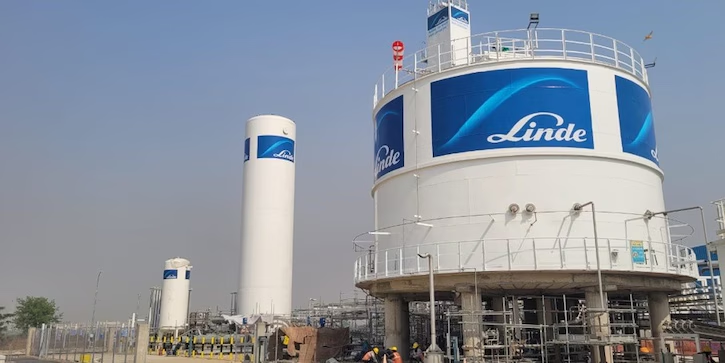
Linde India, operating alongside its subsidiary Praxair India, is one of the two or three companies any large hospital chain is likely sourcing from without even realizing it.
- Combined air separation capacity of more than 2,000 metric tonnes per day across India
- Hyderabad air separation unit came online in late 2023, adding 250 tonnes/day of liquid medical oxygen, nitrogen, and argon
- Reduces regional dependence on oxygen trucked in from other states, cutting logistics risk during demand spikes
- Global backing gives it access to international quality and safety protocols
2. INOX Air Products
INOX operates as a joint venture between the Jain family and Air Products & Chemicals, one of the world’s largest industrial gas companies.
- Palakkad, Kerala plant alone produces roughly 149 tonnes of medical oxygen daily
- Storage capacity of approximately 1,000 nm³ at that single facility
- Sole producer of liquid oxygen in Kerala and the state’s largest oxygen producer overall
- Strong presence across both western and eastern India, not just one regional cluster
3. National Oxygen Limited
National Oxygen has built decades of manufacturing credibility in South India’s industrial gas sector, without the multinational scale of Linde or INOX behind it.
- Long operating history gives it a trusted, established reputation among domestic hospitals
- Focuses on consistent quality control rather than chasing rapid expansion
- Preferred by institutions that specifically want to work with an Indian-owned supplier
- Steady regional presence rather than a nationwide sprawl
4. Goyal MG Gases
Goyal MG Gases became a household name almost overnight during the 2021 shortage, repeatedly named among the companies scaling emergency oxygen production to meet surging demand.
- Demonstrated genuine crisis-response capacity when national supply came under real pressure
- Strong presence across North and Central India
- Returned to steady, dependable operation once emergency demand eased
- Track record built on proven reliability rather than marketing alone
5. Taiyo Nippon Sanso
Taiyo Nippon Sanso brings Japanese engineering discipline to Indian gas production as part of a genuinely global industrial gas technology company.
- International manufacturing and quality-control standards applied to Indian operations
- Backed by decades of gas technology expertise across multiple countries
- Focus on process consistency over rapid, headline-driven expansion
- Serves select industrial hubs with technically demanding purity requirements
6. Ellenbarrie Industrial Gases
Ellenbarrie has built a solid manufacturing base across eastern India, particularly around Kolkata.
- Supplies both industrial and medical-grade oxygen through bulk distribution systems
- Deep regional knowledge of eastern India’s hospital and logistics network
- Plays a critical role in a region that historically had less production capacity than the west
- Known for reliable bulk distribution rather than just cylinder-level supply
7. Bhagawati Oxygen
Bhagawati took an unusual path into the sector — it started as a trader before building its own production infrastructure.
- Originally began as a trading company, then built an on-site air separation plant
- Supplies a nearby copper smelter via direct pipeline alongside broader gas distribution
- Uses cryogenic road tankers to transport liquid oxygen, nitrogen, and argon
- Also active in bio-remediation of wastewater, showing broader industrial gas expertise
8. MVS Engineering
MVS occupies a genuinely different category — it doesn’t sell oxygen gas directly, it manufactures the plants hospitals use to generate their own.
- Positioned as India’s largest manufacturer of on-site oxygen gas plants
- Uses Pressure Swing Adsorption (PSA) technology for high-purity, on-site generation
- Offers VPSA technology for larger requirements above 200 nm³/hr
- Helps hospitals reduce long-term dependence on cylinder deliveries and related costs
9. Sri Venkateswara Oxygen
Sri Venkateswara covers a genuinely significant share of Kerala’s industrial oxygen needs, despite rarely getting national attention.
- Meets roughly 80% of Kerala’s industrial oxygen requirement
- Also produces medical oxygen cylinders specifically for hospital use
- Deep regional distribution network within Kerala
- Complements INOX’s larger Palakkad operation rather than directly competing with it
10. Bellary Oxygen
Bellary Oxygen plays a similar regional role in Karnataka, keeping local hospitals and manufacturing units supplied without the scale of the national players.
- Supports both healthcare institutions and local manufacturing demand
- Maintains a strong quality and timely-delivery focus for its service region
- Shorter delivery routes often mean faster response during local supply disruptions
- Represents the kind of regional backbone that kept many hospitals stocked during 2021
Choosing a Supplier: What Actually Matters
For hospitals, healthcare facilities, or institutional buyers evaluating medical oxygen suppliers, a few practical factors deserve more attention than brand size alone:
- Verify PESO and BIS compliance — the Petroleum and Explosives Safety Organisation and Bureau of Indian Standards approvals aren’t optional paperwork; they’re the baseline safety standard for cylinder design and handling
- Ask about backup and redundancy capacity — a supplier’s liquid oxygen storage and backup arrangements matter more during grid failures or sudden demand spikes than their everyday delivery schedule
- Consider proximity over pure brand size — a regional producer 50 km away often delivers more reliably during emergencies than a national supplier routing tankers in from another state
- Evaluate on-site generation for high-consumption facilities — larger hospitals increasingly find PSA plants from manufacturers like MVS more cost-effective than constant cylinder replenishment
- Confirm batch testing and certification practices — medical-grade oxygen requires documented purity testing for every batch, not just a general quality claim
FAQs
Q1. What’s the actual difference between industrial oxygen and medical oxygen?
They’re produced in the same plants using the same air separation process, but medical oxygen undergoes batch testing and certification to meet pharmacopoeia purity standards (typically 93%±3% or higher). Industrial oxygen skips this certification step, even though the underlying gas is often chemically similar.
Q2. Is it worth a mid-sized hospital investing in its own on-site oxygen generation plant?
For hospitals with consistently high oxygen consumption, PSA plants from manufacturers like MVS Engineering can reduce long-term costs and remove dependence on external cylinder deliveries. Smaller facilities with lower, irregular demand often still find contracted cylinder or bulk liquid supply more practical.
Q3. How can a hospital or clinic verify that a supplier’s oxygen cylinders meet safety standards?
Check for PESO approval, which is mandatory for cylinder design and handling in India, alongside BIS certification on the cylinder itself. Reputable suppliers will readily share these certification documents; reluctance to do so is a genuine red flag.
Q4. Why did some regions face oxygen shortages in 2021 even though India had enough total production capacity?
The shortage was largely a logistics problem, not a production one — most oxygen manufacturing capacity was concentrated in eastern India near steel plants, while demand spiked hardest in the north and west. Since then, manufacturers have added regional plants specifically to reduce this kind of geographic imbalance.