
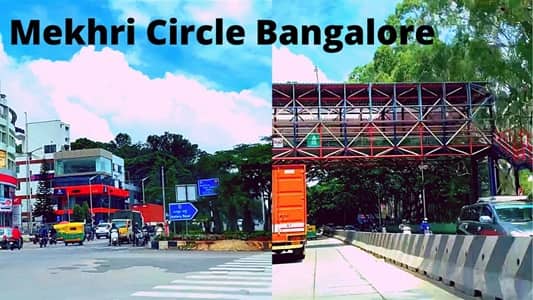
Mekhri Circle Bengaluru has been at the centre of the city’s traffic debate for years — a junction in north-central Bengaluru where the airport corridor, the CBD, and the northern residential belt all converge in a way the road network was never adequately designed to handle. The circle sits in Raj Mahal Vilas Extension in Armane Nagar, PIN code 560006, connecting Sadashivanagar, Hebbal, Yeshwanthpur, CV Raman Road, and Jayamahal Road in a configuration that makes it one of the most heavily loaded junctions in the city. What makes Mekhri Circle significant in 2026 specifically is not its past — it is the ₹2,215 crore infrastructure project that the Karnataka Cabinet formally approved in December 2025 to fundamentally change how traffic moves through this corridor.
Location, Pincode and Administrative Overview
Mekhri Circle Bengaluru is located in Raj Mahal Vilas Extension, Armane Nagar, PIN code 560006. The circle is bounded by Sadashivanagar to the south — one of Bengaluru’s most premium residential localities — and connects northward toward Hebbal, which serves as the primary gateway to Kempegowda International Airport via the Bellary Road corridor. Yeshwanthpur lies to the northwest, and the CV Raman Road corridor connects toward Sanjaynagar, RT Nagar, and the northern residential belt. The circle is part of Bengaluru Central City Corporation (BCCC) jurisdiction, one of five city corporations constituted in September 2025 under the Greater Bengaluru Authority framework.
Why Mekhri Circle Matters for North Bengaluru
Mekhri Circle Bengaluru is not a neighbourhood circle — it is a city-level junction. Every commuter traveling between North Bengaluru and the city’s CBD passes through or near this junction. Airport-bound traffic from South and Central Bengaluru uses the Bellary Road–Hebbal–Mekhri corridor. Residents of Sanjaynagar, RT Nagar, Ganganagar, and Ashwathnagar use this circle to access the rest of the city. Yeshwanthpur’s industrial and commercial activity generates freight movement through this junction. Simultaneously, Sadashivanagar’s wealthy residents and Manyata Tech Park’s professionals converge here during peak hours from the south.
The result is a junction that handles genuinely incompatible traffic types — heavy goods vehicles, airport taxis, corporate cabs, two-wheelers, autorickshaws, and private cars — on a road network that has never had the physical capacity to manage them simultaneously.
The Infrastructure Projects That Will Change This Circle
This is the most important story around Mekhri Circle Bengaluru in 2026 and the next several years. In December 2025, the Karnataka Cabinet approved a ₹2,215 crore project comprising a 2.27 km twin-lane short tunnel at Hebbal Junction and a 1.27 km elevated corridor at Mekhri Circle — part of a broader decongestion strategy for north Bengaluru. The project was approved despite the Finance Department’s reservations about costs, with the Urban Development Department arguing that road widening is not feasible due to land acquisition constraints in the densely built corridor.
Separately, the BDA has floated tenders for a ₹420 crore, 1.6 km four-lane flyover at Mekhri Circle extending from near the Hebbal flyover toward Mekhri Circle (Rotary Junction), with ramps toward Yeshwanthpur, CV Raman Road, and Jayamahal Road. Execution is expected within 18 months from construction start. A new Hebbal flyover loop inaugurated by Deputy CM D K Shivakumar in January 2026 — connecting Nagawara, KR Puram, and Mekhri Circle — has already reduced congestion at Hebbal flyover by approximately 31% compared to previous peak-hour averages, with morning peak reductions of 37%. However, new bottlenecks have emerged downstream as traffic redistributes.
In the Karnataka Budget presented in March 2026, CM Siddaramaiah additionally announced a broader tunnel road and elevated road project from Hebbal Junction to Mekhri Circle at ₹2,250 crore — suggesting either an updated cost estimate or an expanded scope for the same corridor project. Residents and commuters should note that multiple overlapping project announcements exist for this corridor, and confirmed timelines should be verified with BDA and UDD before factoring them into any property or commute planning decisions.
Sadashivanagar and the Surrounding Residential Premium
The immediate residential context of Mekhri Circle Bengaluru is defined by Sadashivanagar to its south — consistently one of Bengaluru’s most expensive and sought-after residential addresses, characterised by large bungalows, tree-lined streets, proximity to the Raj Bhavan, and a civic character that other parts of the city look at with some envy. Property values in Sadashivanagar are among the highest in the city. The circle’s north-facing approach toward Hebbal connects to a different residential profile — Bhadrappa Layout, RT Nagar, and Ganganagar offer mid-segment apartments and independent houses at significantly more accessible price points.
For buyers and renters, proximity to Mekhri Circle means direct access to both Bengaluru’s CBD (Raj Bhavan Road, MG Road corridor) and the airport corridor (Bellary Road), which is a combination few Bengaluru locations offer without significant trade-offs.
Who Uses Mekhri Circle Daily
The daily users of Mekhri Circle Bengaluru span the full social and economic range of the city. Sadashivanagar residents in high-end vehicles. IT professionals from Manyata Tech Park and Hebbal’s office corridors. Government employees heading toward the Secretariat and Raj Bhavan zone. Students and faculty from MS Ramaiah Institute and other Yeshwanthpur-area institutions. Airport-bound travellers who left themselves the standard Bengaluru buffer of an extra 45 minutes. And the residential population of RT Nagar and Ganganagar who pass through this junction twice every working day, every year.
The Ongoing Civic Reality
Despite the new flyover loop and pending projects, Mekhri Circle remains one of Bengaluru’s most congested junctions as of mid-2026. The opening of the Hebbal loop has shifted some pressure, but the downstream redistribution has created fresh bottlenecks at Mekhri Circle itself — a pattern that is well-documented in traffic data. The fundamental problem — too many vehicles of too many different types using the same road space — cannot be fully resolved by any single flyover. The combination of the Hebbal tunnel, the Mekhri elevated corridor, and the Namma Metro expansion proposals for north Bengaluru collectively represent the most serious infrastructure commitment to this corridor that the city has seen, but realistic timelines for all projects to be operational extend to the late 2020s at minimum.
FAQs About Mekhri Circle Bengaluru
Q1. Where exactly is Mekhri Circle in Bengaluru?
Mekhri Circle is located in Raj Mahal Vilas Extension, Armane Nagar, Bengaluru — PIN code 560006. It connects Sadashivanagar, Hebbal, Yeshwanthpur, CV Raman Road, and Jayamahal Road.
Q2. What is the ₹2,215 crore project approved for Mekhri Circle?
In December 2025, the Karnataka Cabinet approved a project comprising a 2.27 km twin-lane tunnel at Hebbal Junction and a 1.27 km elevated corridor at Mekhri Circle to ease chronic traffic congestion in the north Bengaluru corridor.
Q3. Has the Hebbal flyover loop reduced congestion at Mekhri Circle?
Partially. The new loop inaugurated in January 2026 reduced congestion at Hebbal flyover by approximately 31%, but has created fresh downstream bottlenecks at Mekhri Circle itself as traffic redistributes. Full relief requires completion of the planned tunnel and elevated corridor.
Q4. Which metro station is nearest to Mekhri Circle Bengaluru?
There is no operational metro station directly at Mekhri Circle as of mid-2026. The nearest operational stations are on the Purple Line in the Yeshwanthpur direction. Proposed metro expansions for the north corridor may eventually serve this zone more directly.
Q5. Is Sadashivanagar near Mekhri Circle a good area to live in Bengaluru?
Sadashivanagar is among Bengaluru’s most premium residential addresses — well-maintained, well-connected, and close to the CBD and airport corridor simultaneously. The trade-off is very high property prices and the daily traffic challenge at Mekhri Circle, which affects everyone in the northern approach to the city.