
India’s robotics market is projected to grow at more than 24% annually through 2030, reaching roughly $6.8 billion — a pace driven by e-commerce warehouses racing to fulfill orders faster, automakers automating welding lines, and a genuine shortage of factory-floor labor pushing companies toward machines. This list of the top 10 robotics manufacturers in India 2026 covers the companies actually building that automation, from homegrown startups founded by engineering graduates to established global giants running Indian manufacturing operations.
What’s genuinely interesting about this sector right now is the mix: Indian companies are no longer just integrating foreign robots, they’re designing and manufacturing original hardware that competes internationally. Here’s a look at who’s leading that shift.
| Company | Origin | Specialization | Notable Clients/Detail |
| Tata Automation (TAL) | Indian (Tata Group) | Industrial articulated robots | Built India’s first industrial robot, TAL Brabo |
| Addverb | Indian | Warehouse robotics and automation | Rapidly growing homegrown player |
| GreyOrange | Indian | AI-driven warehouse robots | H&M, Adidas, IKEA, Apple, Walmart |
| ANSCER Robotics | Indian | Autonomous Mobile Robots (AMR) | Internal logistics automation |
| Gridbots Technologies | Indian | Pick-and-place, underwater cleaning robots | Indigenous R&D and manufacturing |
| Rapyuta Robotics | Indian (founded 2014) | Cloud-connected warehouse robots | Fleet-wide coordination software |
| Wipro PARI | Indian (Wipro subsidiary) | Large-scale industrial automation | 1,500+ completed projects |
| ABB India | Global (Swiss-Swedish) | Industrial robotic arms | Major share of India’s installed robot base |
| KUKA India | Global (German) | Welding, handling, palletising robots | Strong automotive sector presence |
| Unbox Robotics | Indian | Supply chain and fulfillment robots | Parcel sortation, e-commerce logistics |
1. Tata Automation (TAL)
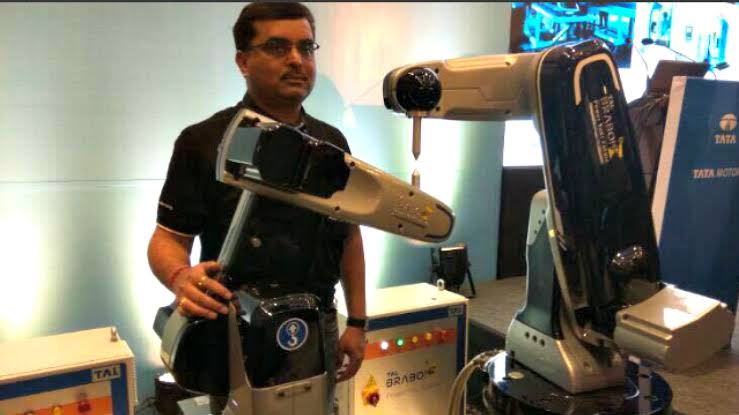
TAL holds a genuinely historic place in Indian robotics — it built the country’s first industrial-articulated robot back in 2016, a milestone that predates much of the current wave of Indian robotics startups.
- Launched the TAL Brabo, India’s first indigenous industrial-articulated robot
- Deployed robotic welding and laser-cutting cells across manufacturing facilities
- Handles material handling and pick-and-place solutions for heavy industrial parts
- Contributes to body-in-white integrated welding lines used in vehicle manufacturing
- Backed by the Tata Group’s broader engineering and manufacturing infrastructure
2. Addverb
Addverb has grown quickly into one of India’s most recognized names in warehouse and supply-chain robotics, riding the same e-commerce boom that’s reshaping logistics globally.
- Specializes in automation solutions built specifically for warehouse and fulfillment environments
- Rapid growth trajectory reflecting strong demand from India’s expanding logistics sector
- Positioned among the homegrown players genuinely competing with international warehouse automation brands
- Represents the broader shift toward Indian-designed robotics rather than purely imported hardware
3. GreyOrange
GreyOrange combines AI software with physical robotics hardware to optimize warehouse operations, and its client list reads like a roster of major global retailers.
- Co-founded by Samay Kohli and Akash Gupta, both BITS Pilani graduates
- Core platform GreyMatter coordinates robots, human workers, and warehouse operations in real time
- Ranger robot series handles goods-to-person picking, assisted picking, and inventory movement
- Customers include H&M, Adidas, IKEA, Apple, and Walmart
- Maintains R&D and manufacturing facilities in Bengaluru, with a second base in Delhi NCR
4. ANSCER Robotics
ANSCER focuses specifically on Autonomous Mobile Robots, a category increasingly essential for factories and warehouses looking to automate repetitive internal logistics tasks.
- Developed mobile robot systems on a patented AMR platform
- Simplifies mobile robot deployment for businesses optimizing internal logistics
- Targets automation of monotonous or physically risky tasks on the shop floor
- Growing relevance as manufacturers increasingly prioritize shop-floor efficiency and worker safety
5. Gridbots Technologies
Gridbots has built its identity around indigenous research and manufacturing, covering a genuinely diverse product range that goes beyond standard industrial automation.
- Offers both pick-and-place robots and underwater cleaning robots, a notably unusual combination
- Strong emphasis on indigenous research positions it as a key domestic manufacturing player
- Diversified product range reduces dependency on any single industrial application
- Represents the kind of specialized innovation emerging outside India’s major metro robotics hubs
6. Rapyuta Robotics
Rapyuta Robotics has built its business around cloud-connected robotics, taking a distinctly software-forward approach compared to purely hardware-focused competitors.
- Founded in 2014, specializing in cloud-connected warehouse robots
- Cloud connectivity enables fleet-wide coordination and real-time optimization across multiple robots
- Positioned at the intersection of robotics hardware and cloud software infrastructure
- Growing relevance as Indian warehouses increasingly demand connected, data-driven automation systems
7. Wipro PARI
Wipro PARI brings decades of large-scale industrial automation experience into India’s robotics landscape, backed by Wipro’s broader engineering and technology resources.
- Specializes in large-scale industrial automation projects rather than standalone robotic units
- Solutions include robotic assembly lines, material handling systems, and vision-guided robotics
- Also covers welding and inspection robots for demanding manufacturing environments
- Has completed over 1,500 projects, reflecting genuine depth of implementation experience
8. ABB India
ABB India represents the Indian operations of a major global automation company, and it holds a significant share of India’s installed industrial robot base alongside a handful of other international players.
- Manufactures robots for assembly, welding, and packaging lines with industry-grade precision
- Part of the group of companies (alongside Fanuc, KUKA, Yaskawa, and Kawasaki) accounting for roughly 70-75% of India’s installed industrial robot base
- Offers complete industrial automation equipment beyond just robotic arms, including drives and control systems
- Serves manufacturers seeking integrated automation rather than piecemeal robotic units
9. KUKA India
KUKA brings its globally recognized orange robotic arms into Indian manufacturing, with particularly strong penetration in automotive and heavy machinery sectors.
- Known specifically for welding, handling, palletising, and assembly applications
- Strong presence in India’s automotive manufacturing sector, where welding automation matters most
- Delivers flexibility and control valued in heavy machinery production environments
- Recognized globally alongside ABB as one of the dominant industrial robotics suppliers
10. Unbox Robotics
Unbox Robotics has carved out a specialized position in supply chain and fulfillment robotics, focused specifically on the logistics challenges e-commerce growth has created.
- Specializes in robotics-based fulfillment and distribution for e-commerce, retail, and logistics
- Robotic systems significantly enhance parcel sortation speed for express logistics operations
- Focused on order fulfillment productivity rather than broader industrial manufacturing applications
- Represents the growing niche of robotics companies built specifically around India’s booming e-commerce sector
Choosing the Right Robotics Solution: What Actually Matters
Selecting a robotics manufacturer or system depends heavily on your specific application, not just brand recognition:
- Match the robot type to your task — fixed industrial-articulated robots suit repetitive assembly or welding, while AMRs work better for flexible internal logistics and material movement
- Consider payload and precision requirements carefully — heavy automotive welding needs different specifications than delicate electronics assembly
- Evaluate integration with existing systems — a robot that doesn’t communicate well with your current warehouse or factory management software creates more problems than it solves
- Factor in safety compliance standards — robots working alongside human staff need proper safety certifications and collision-avoidance systems, not just raw performance
- Ask about local service and support infrastructure — international brands like ABB or KUKA offer proven technology, but confirm service response times in your specific region
FAQs
Q1. What’s the real difference between an AMR and a traditional industrial robotic arm?
An AMR (Autonomous Mobile Robot) moves independently around a facility to transport goods or materials, while a traditional industrial robotic arm stays fixed in place performing repetitive tasks like welding or assembly. Warehouses typically need AMRs for logistics, while manufacturing lines often need fixed arms for precision assembly work.
Q2. Is robotics automation genuinely affordable for small and medium manufacturers in India, or only large companies?
Costs have dropped significantly as Indian manufacturers like Addverb and ANSCER build more affordable domestic alternatives to expensive imported systems. Many businesses now start with a small number of AMRs and scale gradually, avoiding the large upfront investment that once made automation feasible only for big enterprises.
Q3. Do factory workers need specialized training to work alongside industrial robots?
Yes, basic safety training is essential, along with familiarity with the specific robot’s control interface and emergency stop procedures. Most manufacturers, including ABB and KUKA, provide training programs as part of their implementation packages, reducing the learning curve considerably.
Q4. Which Indian industries are adopting robotics fastest right now?
Automotive manufacturing, e-commerce warehousing, and electronics assembly currently represent the largest adopters of robotics technology in India. E-commerce logistics specifically has driven much of the recent growth in homegrown Indian robotics companies like GreyOrange and Unbox Robotics.