
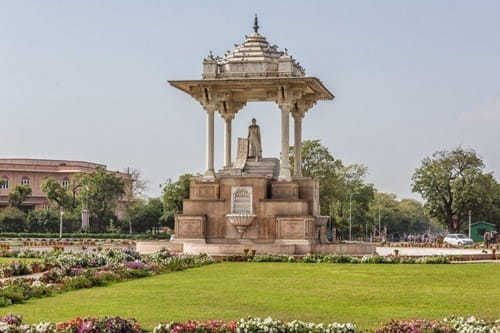
Statue Circle Jaipur carries the distinction of being the most personally meaningful landmark in a city full of landmarks — because it is the only major circle in Jaipur named not for a function, a gate, or a geography, but for the man who built the city. Maharaja Sawai Jai Singh II founded Jaipur in 1727, planned it as a grid-based city that broke from the hilltop fortress tradition of Rajput capitals, commissioned the Jantar Mantar observatories across India, and governed with a scholarly precision that made him one of the most intellectually distinguished rulers of 18th-century India. The 5-metre-tall white marble statue at the centre of this circle depicts him holding an astrological diagram — specifically a planisphere — and a telescope, both references to his lifelong passion for astronomy and mathematics. The circle was erected in 1967 to mark the 240th anniversary of Jaipur’s founding.
Location and the C-Scheme Belt
Statue Circle’s address is Jai Singh Circle, Ashok Nagar, Jaipur, Rajasthan 302001. It sits on Prithviraj Road, adjacent to C-Scheme — Jaipur’s most prestigious commercial and residential zone — and next to Central Park, Jaipur’s largest public garden, where the tallest National Flag in the city flies. Amar Jawan Jyoti, the flame-lit soldiers’ memorial, is 1.5 km away. Birla Mandir, the white marble temple on a hilltop at the edge of Moti Doongri, is 2 km. Albert Hall Museum and Ram Niwas Garden are accessible from the same Prithviraj Road corridor. The Rajasthan Legislative Assembly (Vidhan Sabha) is nearby, making the Statue Circle-C-Scheme zone the convergence point of Jaipur’s civic, institutional, and social upper tier.
Jaipur Junction Railway Station is approximately 3.2–4 km from the circle. Jaipur International Airport is approximately 10–11 km. The nearest Jaipur Metro station is Civil Lines — approximately 1.5 km from the circle, accessible by e-rickshaw or auto for metro connectivity toward Mansarovar and the western city corridor.
The Statue: White Marble, Astrological Detail, and Evening Light
The statue is carved from white Jaipuri marble — the same material used for the Birla Mandir and countless heritage structures across Rajasthan, a material that reads differently in light and shadow at different times of day. The depiction of Jai Singh II holding a planisphere is not decorative: he established five Jantar Mantar observatories across India (Jaipur, Delhi, Ujjain, Mathura, and Varanasi), built in the 1720s–1730s and still among the largest stone astronomical instruments in the world. The Jaipur Jantar Mantar is a UNESCO World Heritage Site. His statue’s astrological diagram is the memorial’s acknowledgment of this specific intellectual legacy.
After sunset, multi-coloured fountain illumination and well-designed lighting turn the circle into one of Jaipur’s most photographed night scenes. Locals describe 6 PM onwards as the best time to visit. The circle is open 24 hours, with no entry fee.
The C in Statue Circle Stands for Coffee
A local joke that has achieved near-universal circulation in Jaipur’s social media geography: “The C in Statue Circle stands for Coffee.” The area around the circle is known for coffee stalls, kulhad chai vendors, and cafes that sustain late-evening footfall from residents of C-Scheme, Ashok Nagar, and the broader central Jaipur belt. Kaleidoscope restaurant, Jaipur Grill, and Tan Sukh for Rajasthani cuisine are among the named dining options in the immediate zone. Morning joggers use Central Park 500 metres away. Evening walkers use the circle’s own garden perimeter. The circle operates as a continuous people-space from early morning through midnight.
Connectivity and Getting Around
Three routes lead to Statue Circle from Jaipur Bus Station — by NH-62 via Mathura Das Mathur, by High Court Road via Chopasni Road, and by Pal Road via ITI Road. All city buses heading toward C-Scheme or Ashok Nagar stop here. The Jaipur Metro Phase 2 Orange Line, approved by the Union Cabinet in April 2026 — 42.80 km from Prahladpura to Todi Mod, ₹13,037 crore, 36 stations, completion target September 2031 — does not directly serve the Statue Circle zone, but will improve metro reach across the city when operational.
FAQs About Statue Circle Jaipur
Q1. Who is the statue at Statue Circle Jaipur?
The statue is of Maharaja Sawai Jai Singh II — the founder of Jaipur, born 1688, who founded the city in 1727. He is depicted holding a planisphere and telescope, referencing his lifelong passion for astronomy and his establishment of five Jantar Mantar observatories across India. The statue is 5 metres tall, carved from white Jaipuri marble.
Q2. What is the official name of Statue Circle Jaipur?
The official name is Sawai Jai Singh Circle. Statue Circle is the universally used popular name. The address is Jai Singh Cir, Ashok Nagar, Jaipur, Rajasthan 302001.
Q3. What year was Statue Circle built?
The circle was erected in 1967 to mark the 240th anniversary of Jaipur’s founding in 1727.
Q4. How far is Statue Circle from Jaipur Railway Station and Airport?
Jaipur Junction Railway Station is approximately 3.2–4 km away. Jaipur International Airport is approximately 10–11 km. The nearest Jaipur Metro station is Civil Lines, approximately 1.5 km from the circle.
Q5. What is the best time to visit Statue Circle Jaipur?
After 6 PM, when the fountain illumination and multicoloured lights are active and the coffee and street food culture is at its most animated. The circle is free, open 24 hours, and best visited October to March when Jaipur’s evenings are cool and pleasant.