
Horniman Circle Mumbai holds a position in the city’s history that no other public space can claim. This 2.5-acre circular garden in the Fort district of South Mumbai was the literal epicentre of Bombay’s commercial and civic life for over two centuries — as Bombay Green in the 18th century, as Elphinstone Circle in the 19th, and as Horniman Circle from 1947 to the present. The story of how cotton merchants trading under a banyan tree here eventually created the Bombay Stock Exchange, and how an Irish journalist editing a pro-independence newspaper got a colonial-era garden renamed in his honour, is the kind of history that turns a public garden into something more than a park.
The Name: Who Was Benjamin Horniman?
Benjamin Guy Horniman was an Irish-born journalist who came to India as editor of The Bombay Chronicle — a newspaper started in 1910 by Sir Pherozeshah Mehta specifically as a pro-Indian English publication to counter the existing pro-British press. Horniman’s editorial work in support of Indian independence reached its defining moment when he became the first journalist to publish detailed accounts of the Jallianwala Bagh massacre in 1919, bringing global attention to British atrocities. The British colonial government deported him back to England in response. He was not finished: using a legal loophole, he returned to India in 1926, continued his editorial work, and died in India in 1948. When independence came in 1947, Elphinstone Circle — the colonial name of the garden — was renamed Horniman Circle in his honour. Few places in Mumbai are named after Englishmen, and fewer still after Irishmen who specifically opposed British rule.
From Bombay Green to BSE: The Origin Story
Bombay Green in the early 19th century was the commercial heartland of the walled city — a vast open space where cotton and opium were actively traded, stretching from the old Secretariat and Government House on Apollo Street southward to the Town Hall building. The Bombay Stock Exchange’s foundational moment happened here: cotton merchants who met daily under a particular banyan tree decided in the 1850s to formalise their arrangement, with 22 of them contributing a rupee each to establish the Native Share & Stockbrokers’ Association — which eventually became the Bombay Stock Exchange. The BSE’s current home at Phiroze Jeejeebhoy Towers on Dalal Street sits adjacent to the original Horniman Circle zone, a few hundred metres from where those merchants first gathered.
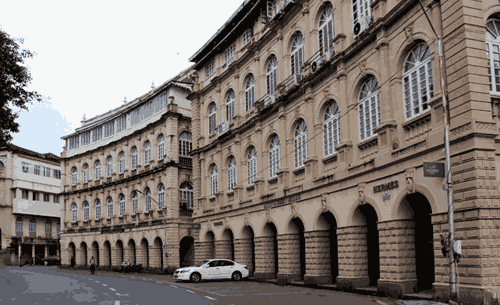
The formal garden was created in 1872 as part of Governor Bartle Frere’s urban redesign project — demarcating the original Bombay Green into a central circular park and a surrounding semi-circle of commercial buildings. The architectural ensemble designed by James Scott applied strict controls on fenestration, form, and skyline, creating a coherent neoclassical ring of buildings around the garden that remains largely intact.
The Institutional Ensemble
Standing at Horniman Circle today and looking outward, the buildings that ring the garden form one of India’s most concentrated clusters of institutional prestige. The Asiatic Society of Mumbai’s Town Hall — completed in 1833 and one of the earliest examples of neoclassical architecture in Mumbai — faces the garden directly. Its 30 weathered Doric steps lead to a library holding over 100,000 books, including 15,000 rated as unique and invaluable, among them one of only two known original copies of Dante’s Divine Comedy. Nearby, in Nariman Street, stands St Thomas’ Cathedral — the first Anglican church in Mumbai, consecrated in 1718, whose tower appears in photographs of Bombay Green from the 1860s. The Reserve Bank of India’s regional headquarters, the BSE on Dalal Street, and multiple nationalised bank headquarters complete the financial institutional ring.
Horniman Circle is described in the research publication “Zero Point Bombay: In and around Horniman Circle” — funded by the Ford Foundation and the Prince Claus Fund — as the zero point of Bombay’s urban identity. That framing reflects the scholarly consensus: this is not peripheral heritage. It is the city’s origin point.
The Garden Today
The 2.5-acre garden, managed by BMC, was restored in 2024 with the central fountain’s ornamental elements refurbished. Access is free. The garden is used daily by office workers from the surrounding banking and financial district for lunch breaks — the lunchtime crowd of professionals relaxing on the shaded lawns is the circle’s characteristic daily scene. Exercise machines, jogging tracks, a play area for children, and benches flanking the central pathway provide structured amenity. Ruhaniyat, the annual Sufi and mystic music festival, is one of the cultural events hosted at Horniman Circle. The Kala Ghoda Arts Festival connects the Horniman Circle zone to the broader Fort-Kala Ghoda heritage arts circuit annually.
Connectivity
Chhatrapati Shivaji Terminus (CST) and Churchgate are the two railway stations serving the Fort zone — both within approximately 10-minute walking distance. The circle is equidistant from both, reflecting its central position in South Mumbai’s heritage and financial district. CST serves Central Line and Harbour Line; Churchgate serves Western Line.
FAQs About Horniman Circle Mumbai
Q1. Why is it called Horniman Circle in Mumbai?
A: Named after Benjamin Horniman — an Irish journalist and editor of The Bombay Chronicle who published the first accounts of the Jallianwala Bagh massacre and actively supported Indian independence. Deported by the British, he returned to India and died there in 1948. After independence, the former Elphinstone Circle was renamed in his honour in 1947.
Q2. What was Horniman Circle called before independence?
A: Elphinstone Circle — named during the colonial period. Before that, the open space was known as Bombay Green from the 18th century. The garden as a formal circular park was created in 1872.
Q3. What is the Asiatic Society at Horniman Circle?
A: The Asiatic Society of Mumbai occupies the Town Hall building directly facing the garden, completed in 1833. Its library holds over 100,000 books, including 15,000 unique and invaluable titles and one of only two known original copies of Dante’s Divine Comedy.
Q4. What is the connection between Horniman Circle and the Bombay Stock Exchange?
A: Cotton merchants who gathered daily under a banyan tree on what was then Bombay Green collectively established the Native Share & Stockbrokers’ Association in the 1850s — which became the BSE. The exchange’s current building on Dalal Street is steps from the original site.
Q5. How do you reach Horniman Circle in Mumbai?
A: Chhatrapati Shivaji Terminus (CST) and Churchgate Railway Station are both within 10 minutes’ walk. The circle is in the Fort district of South Mumbai, accessible from either mainline station via the Fort’s well-signposted heritage street network.